
Cloud task scheduling: sovereignty and automation for small businesses
Published on · Updated on

To automate AI and GPU jobs while keeping control of your data, choose a sovereign cloud environment that pairs AI-driven scheduling with a deterministic engine. That combination removes the usual trade-off between getting started quickly and keeping real control over your infrastructure. For a Québec small business, Cloud OS is a good illustration of the approach: the AI picks the right compute method, execution stays hosted locally, and the whole thing is billed as a single all-inclusive subscription, with a monthly usage gauge rather than an invoice per job.
In brief:
- Cloud task scheduling has to guarantee reproducible results, through a deterministic engine and complete logging.
- Small businesses can benefit from local solutions such as Cloud OS, which bundle everything into one subscription and host data in Québec.
- Keeping costs under control comes down to validating in a sandbox, industrializing with Infrastructure as Code and managing GPU resources efficiently.
- Public funding, such as the AI Compute Access Fund, offers up to $3.35 million toward eligible costs.
- Data governance and periodic human review remain essential to preserve traceability and limit risk when automating processes.
Table of contents
- Which workloads does cloud task scheduling cover?
- What should you check before choosing a scheduling platform?
- How do you roll out cloud task scheduling without breaking everything?
- What funding exists for access to computing power?
- How do you keep control over your data and automated decisions?
- What small businesses underestimate in their move to cloud automation
- Cloud OS: AI-driven scheduling, executed locally
- Sources
- Frequently asked questions
Which workloads does cloud task scheduling cover?
Cloud task scheduling means ordering and automating computing jobs described in plain language: GPU compute, 3D rendering, geospatial processing, web scraping or simulations. It also goes by job scheduling or cloud cron, depending on the technical context, but the principle stays the same: describe a need, then let a system choose and run the right compute method.
The most common workloads at Québec small businesses break down like this:
- GPU compute for training AI models or running inference
- 3D rendering for animation, Blender modelling or architectural visualization
- Geospatial processing (GIS) for analyzing drilling data or mapping territory
- Web scraping for competitive intelligence or gathering public data
- Scientific simulations for modelling industrial processes
A geotechnical engineering firm in Abitibi-Témiscamingue, for instance, regularly processes drilling data in QGIS to produce reports that meet NI 43-101. A regional video production house schedules 3D renders in batches during off-peak hours to cut its compute costs. A small manufacturer, for its part, can run process simulations without owning a GPU server.
Connectivity is still a real constraint outside the large centres. Limited internet links in Abitibi-Témiscamingue or on the Côte-Nord often make batch processing more dependable than real-time compute: you transfer the data once, launch the job, and collect the result without depending on a stable connection for hours.
What should you check before choosing a scheduling platform?
Choosing a cloud task scheduling provider takes more than a price comparison. Here are the six checks to run before you sign:
- Data residency and the subcontracting chain. Ask where the servers are hosted and who has access to them, including any subcontractors.
- Deterministic engine and logging. Require every run to produce a reproducible result, with logs and run hashes kept for audit.
- GPU availability and service commitments. Check how long it takes to get GPU resources at peak times, and what availability guarantees come with them.
- Infrastructure as Code and containerization. Both practices, recommended in the Québec government’s policy statement on cloud computing, make audits easier and cut maintenance costs in production.
- Pricing model. Weigh usage-based credits against monthly subscriptions, depending on how regular your needs are.
- French-language technical support. Being able to get help in French matters when a job fails in the middle of the night.
Pro tip: Always ask for concrete proof of reproducibility before you sign. Have the same job run twice with the same parameters, then compare the results bit for bit. If the provider cannot demonstrate that, its engine probably is not deterministic.
How do you roll out cloud task scheduling without breaking everything?
Going from a prototype to dependable production follows a logical progression. Here are the five steps to respect.
- Define your deliverables and classify your data. Before any code, spell out what the job has to produce, how success will be measured, and which sensitivity level your data belongs to (public, internal, confidential).
- Prototype in an isolated environment. Test reproducibility and performance in a sandbox before exposing anything to real data.
- Industrialize with Infrastructure as Code. Automate deployments and tests through containers, so you avoid the manual configurations that drift over time.
- Manage GPU capacity intelligently. Book short blocks of compute rather than persistent instances, and favour off-peak batch queues to bring the bill down.
- Put monitoring and auditing in place. Every run should produce logs you can consult and artifacts kept under a clear retention policy.
Pro tip: To optimize GPU costs, quantizing models before training or inference often reduces the compute load without sacrificing accuracy, a practice Calcul Québec confirms for intensive workloads.
A cluster like Rorqual, run by Calcul Québec with a 200 Gb/s connection and job tracking through a portal, shows concretely what compute capacity hosted in Québec with built-in monitoring looks like.
What funding exists for access to computing power?
Access to specialized GPUs is often the main obstacle for a small business. Two public programs deserve your attention:
- The AI Compute Access Fund can cover up to $3.35 million in cloud services, for eligible compute costs between $100,000 and $5 million over three years. Eligibility is limited to businesses of fewer than 500 employees incorporated in Canada.
- The Sovereign AI Compute Infrastructure Program (SAICIP) aims to build national public capacity, with an infrastructure-building stream and a national service stream that should, in time, widen what is available to businesses.
Prepare your three-year cost projections and your data governance documentation before you apply: both come up in the evaluation criteria every time. While you wait for an answer, spreading heavy jobs across several months and favouring a provider whose monthly price is fixed remain simple operational tactics for keeping the bill flat.
How do you keep control over your data and automated decisions?
Automating jobs does not mean giving up traceability. Solid governance rests on four pillars:
- Systematic classification of data by sensitivity, with access rules that follow directly from it.
- Periodic human review of agentic systems, rather than blind trust in automation.
- Complete logging of every run, keeping the artifacts (input hash, container image, signed logs) so you can answer an audit.
- Infrastructure as Code applied as standard practice, not as a one-off exception.
The broad digital transformation trends documented by the Québec government insist on this pairing of AI and human governance: a system that decides on its own, with no periodic checks, always ends up drifting.
Local hosting is not only a matter of principle. It measurably reduces the contractual risks tied to foreign jurisdictions and simplifies compliance with the provincial cloud computing guidance, which explicitly recommends scalability, security and resilience as architecture criteria.
What small businesses underestimate in their move to cloud automation

Most owners approach cloud task scheduling as a cost problem. That is the wrong priority. The real risk is picking a provider that optimizes for speed without guaranteeing reproducibility: a job that returns a different result on every run costs more in corrections than it ever does in raw compute.
For a small business outside the large centres, the logical order is still: validate in a sandbox, industrialize with Infrastructure as Code, and only then look for outside funding. The companies that reverse that order end up with subsidized infrastructure they never really master.
— Maxime
Cloud OS: AI-driven scheduling, executed locally
Looking for an environment where describing a task in plain language is enough to trigger the right processing, with no installation and no heavy technical configuration? That is exactly what Cloud OS does. The AI selects the appropriate compute method, the deterministic engine guarantees that every run produces an exact, reproducible result, and your data stays on servers owned in Québec.
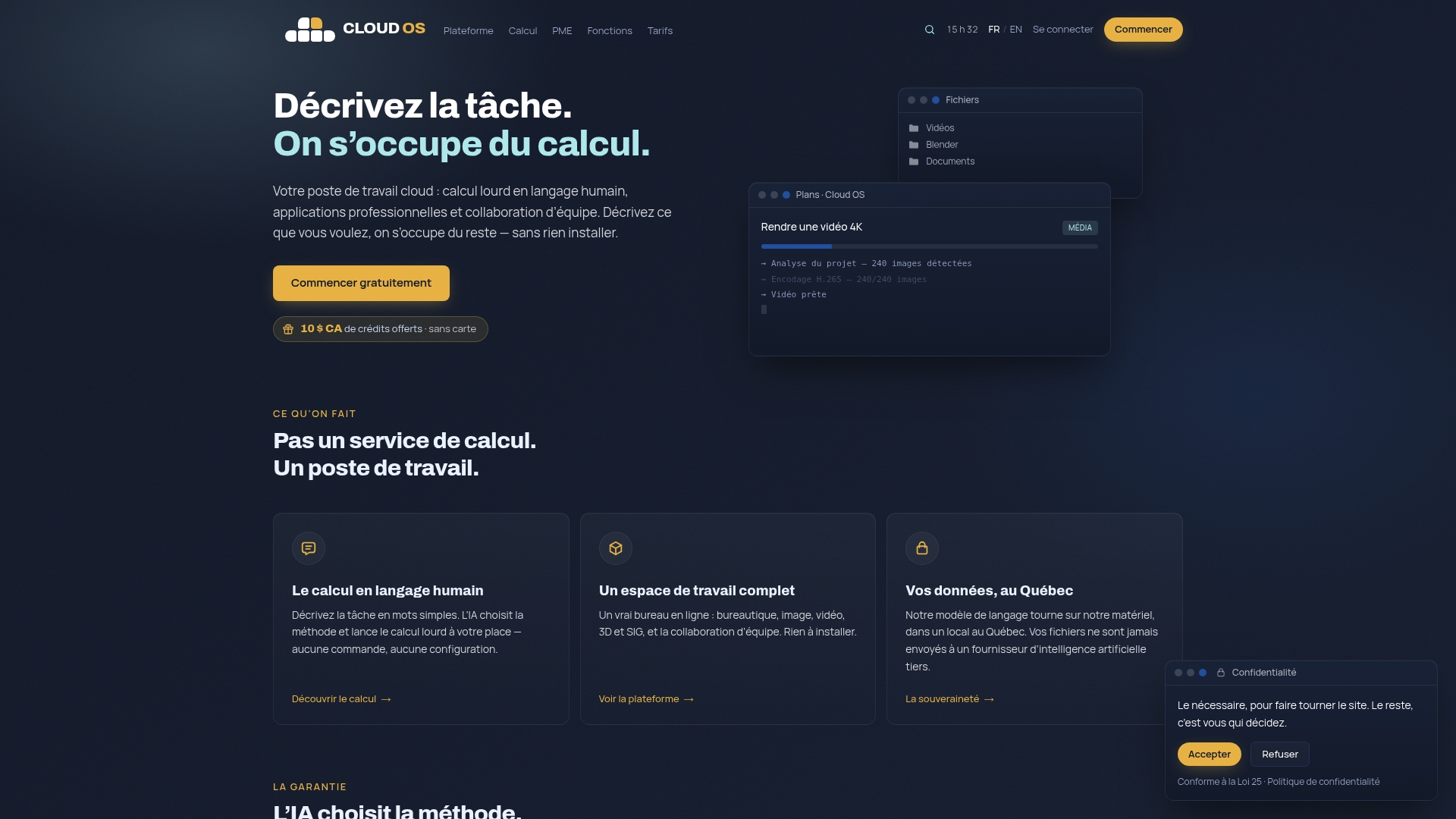
In concrete terms, Cloud OS covers the use cases above — geomatics and GIS, 3D rendering, GPU compute — without you having to manage a cluster or negotiate an infrastructure contract, and all of it draws on the monthly allowance included in your plan rather than on a separate invoice. The Sandbox, a persistent desktop, comes with the Business plan, and a 14-day trial with no card lets you check reproducibility before you commit; the pricing page sets out the two plans, Personal at 10 $ CA a month and Business at 60 $ CA a month for heavier needs.
Start by estimating your monthly volume of tasks and comparing it with the allowance each plan includes, shown on the pricing page: that is the simplest starting point for judging whether the approach suits you.
Sources
- Fonds d’accès à une capacité de calcul pour l’IA – Donner aux PME canadiennes les moyens d’utiliser l’intelligence (in French)
- Énoncé d’orientations en infonuagique et en hébergement | Gouvernement du Québec (in French)
- Services aux entreprises | Calcul Québec (in French)
Frequently asked questions
What exactly is cloud task scheduling?
It is the ordering and automation of computing jobs — GPU compute, 3D rendering or web scraping, for example — driven in plain language within a cloud environment. A system decides which compute method to apply, then runs it reproducibly.
How much does access to a scheduling environment like Cloud OS cost?
The full details are on the pricing page.
What is a deterministic engine, in practical terms?
It is a system that produces exactly the same result every time the same job runs with the same parameters, unlike probabilistic systems whose outputs vary. That guarantee is essential for audits and compliance in a professional setting.
Is the AI Compute Access Fund meant for my small business?
It targets Canadian businesses of fewer than 500 employees, incorporated in Canada, with eligible compute costs between $100,000 and $5 million over three years, for funding of up to $3.35 million. Check the exact criteria before you apply.
Why does data sovereignty matter for AI automation?
Hosting your data and processing on servers located in Québec reduces the contractual risks tied to foreign jurisdictions and makes it easier to comply with provincial cloud computing guidance. It is also a condition often required for sensitive data, such as geological reports that meet NI 43-101.